Launch a kayak from Cascada's private river park on a September evening and paddle downstream for ten minutes. The current is doing most of the work, sliding you past a bank of live oaks old enough that some of them were already mature when the first ranches went up along this stretch of the Guadalupe. At what point does that water stop being a river and start being the lake the listings promised you?
The honest answer is: not here. Not yet.
Where the River Ends and the Lake Begins
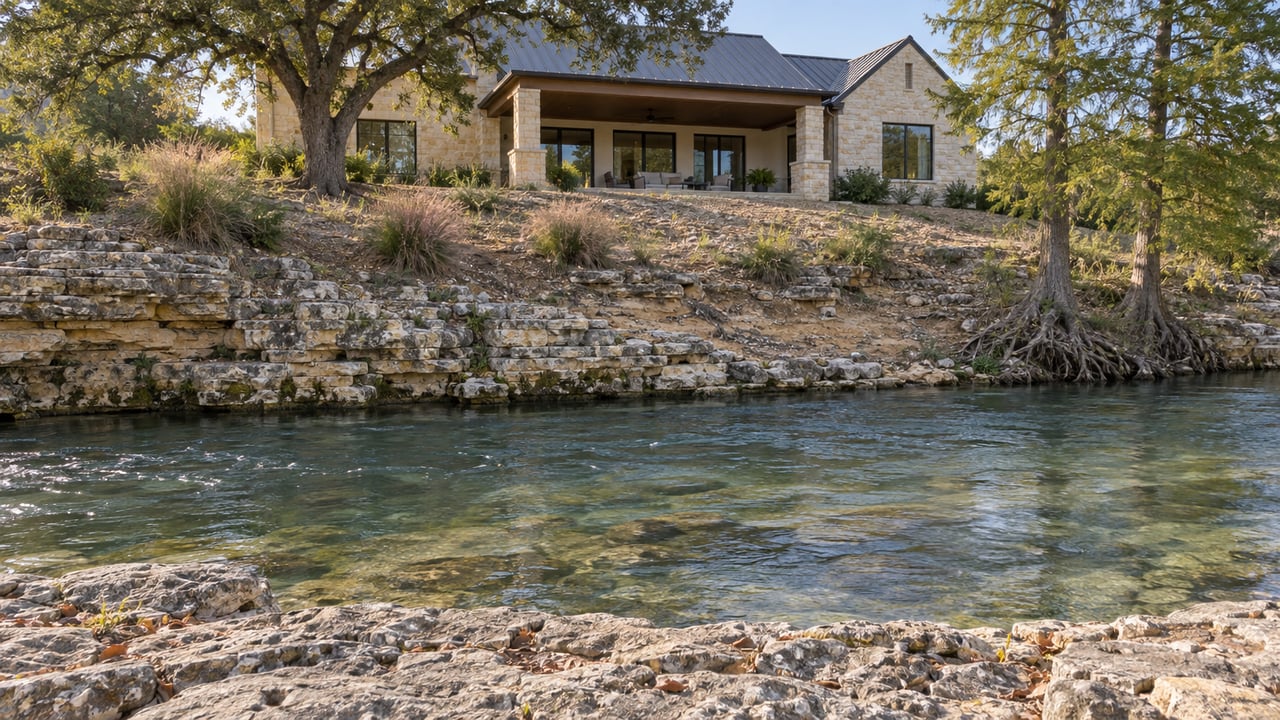
Cascada at Canyon Lake sits on a section of the Guadalupe that river guides and paddling clubs still classify as free-flowing, not impounded. American Whitewater's river guide for this stretch notes that the rapid just downstream of Rebecca Creek Crossing is the last one before the Guadalupe flows into Canyon Lake, which places the community's own river frontage on the final mile of open current before the reservoir takes over. Canyon Lake itself is a dam-controlled impoundment further south. What sits behind Cascada's gate is something different: a spring-fed river that still behaves like a river, rising after rain and thinning out during dry stretches, with current instead of the flat surface a reservoir holds all year.
That distinction matters more than it sounds like it should. A listing that promises kayak access to Canyon Lake is technically accurate if you're willing to paddle far enough, but the water at the dock is river water, and river water has moods a lake doesn't. It drops. It clears after a few dry weeks and turns silty after a hard rain. It has a current you paddle with in one direction and against in the other. None of that shows up in a real estate photo, and all of it shows up the first time you try to launch after a dry August.
The Same River, a Public Ramp Away
Five minutes outside Cascada's gate, at Rebecca Creek Road Bridge, that same river is public. Paddling guides describe it as a beginner-level put-in with a boat ramp and parking, gentle current suited to basic strokes and steering, no permit or fee required. The Texas Parks and Wildlife Department has designated the stretch from Nichol's Landing down to Rebecca Creek Crossing as an official paddling trail, a run of just under ten miles that ends more or less where Cascada's private water begins.
That overlap is worth knowing if you've ever wondered why a stranger's kayak occasionally drifts past your own dock on a Saturday afternoon. The public trail and the private park share the same river, just not the same gate. Paddlers who put in upstream at Nichol's Landing are finishing a trip that lands them at the edge of a neighborhood most of them will never enter. The people who live inside the gate are launching into water that a much wider public already treats as one of the better beginner floats in the San Antonio area, precisely because it stays clear and calm compared to the crowded party stretch below Canyon Dam.
None of that changes with the seasons the way a lake would. Reservoir levels rise and fall on one schedule. This section of river answers to rainfall, which means the honest habit before any paddle, private park or public ramp, is checking flow conditions rather than assuming the water will look the way it did last time.
What the Trail Actually Covers
The river isn't the only thing that runs through Cascada. A network of walking, hiking, biking and running trails extends for miles alongside the spring-fed creek that feeds the property, threading under a canopy of oaks that predate the subdivision by a century. The trail eventually opens onto Riverside Park and Pavilion, which carries a playground, a soccer field, picnic tables and a set of BBQ pits, the kind of shared space that gets used for birthday parties and Sunday cookouts rather than anything more organized.
It rarely feels crowded, and there's a simple reason for that. Community profile data for Cascada at Canyon Lake puts the population at roughly 102 residents, a number small enough that the trail and the pavilion function more like a shared backyard than a public amenity. On the neighborhood's Nextdoor page, the interests residents list most often are dogs, walking, gardening, home improvement, wine tasting, BBQ and grilling, and fishing, the texture of a place where people are more likely to run into a neighbor's Labrador on the trail than a stranger.
That same trail corridor sits inside a wildlife habitat that Texas Parks and Wildlife documents along this part of the Guadalupe: deer, armadillos, foxes, squirrels and river beavers move through the limestone bluffs and cypress stands that line the water, and it isn't unusual to see livestock watering at the river's edge on the properties upstream. A quiet walk along Cascada's creek trail in October is as likely to turn up a doe crossing thirty yards ahead as it is another dog walker.
Checking Conditions Before You Launch
The practical habit that separates a good afternoon on this stretch from a frustrating one comes down to a short list of things worth confirming before you carry a kayak down to the private park:
- Recent rainfall in the watershed, since this section rises and falls with rain rather than dam releases
- Current flow, which paddling guides for this stretch describe as gentle and beginner-friendly under normal conditions but capable of dropping to a crawl during dry spells
- Whether you're launching for a short paddle within the private park or planning to go further downstream toward the public takeout at Rebecca Creek, since the two are the same river but not the same trip
None of this requires more than a few minutes of checking before you head out, but it's the difference between a lazy float past the oaks and a slog through ankle-deep water because the last real rain was three weeks ago.
The River You Actually Live On
The version of Cascada that shows up in a listing photo is a still image of blue water and green banks. The version residents actually use is a moving one, a spring-fed stretch of the Guadalupe that happens to end its free-flowing run right where the neighborhood's private park sits, a few hundred yards upstream of where it becomes the lake. Paddling out from the dock on a clear October morning means paddling on a river with its own rhythm, not a reservoir with a fixed shoreline, and that's worth knowing whether you've lived behind the gate for ten years or ten weeks.
If you're curious what else sits along this stretch of the Hill Country, from the trail systems to the water itself, Ashley Lomas is always glad to talk through it. Let's Connect.
This article is general information, not legal, tax or financial advice. Consult a qualified professional about your situation.